
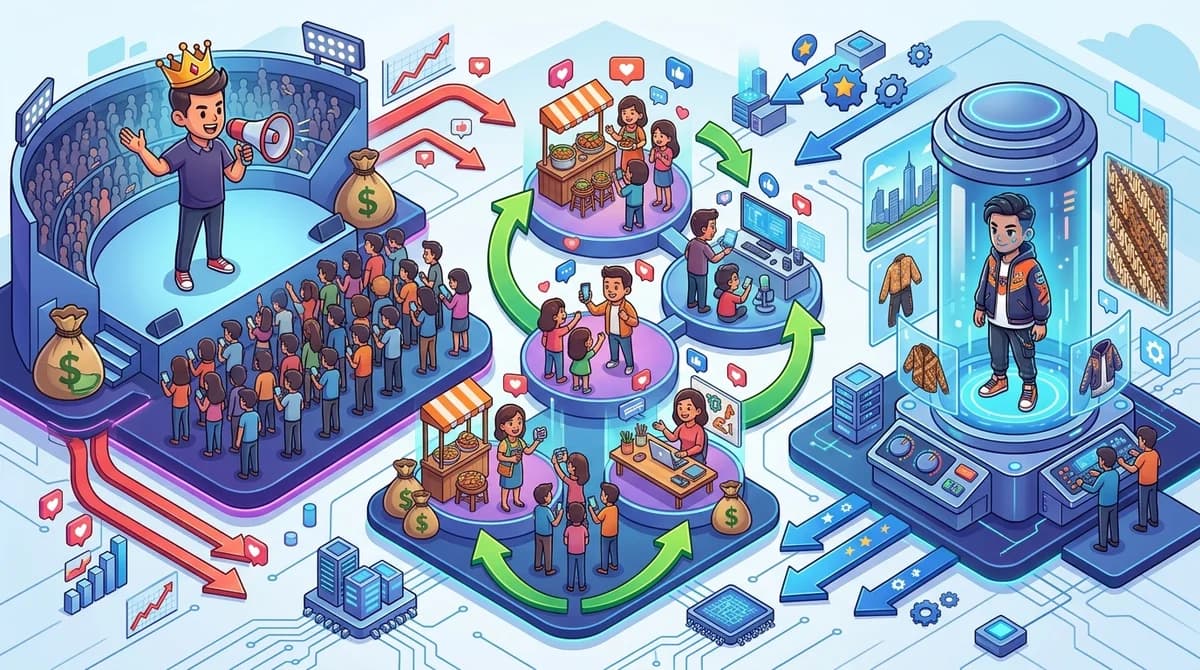

The Power of Proximity: Why Nano-Influencers and Virtual Personas Are Now Stealing Brands' Attention
Imagine you are scrolling through your social media timeline and see a top celebrity with millions of followers promoting a facial moisturizer product. You may be amazed by the aesthetics of her photos, but there's a glimmer of doubt: does she actually use them every day? In another corner of the timeline, an old friend or a plant hobbyist with a thousand followers tells an honest story about the organic fertilizer he just tried. Without realizing it, you trust the second recommendation more. This is a phenomenon that is fundamentally changing the digital marketing landscape.
The glorious era of mega-influencers who rely on massive reach is starting to reach a saturation point. Currently, global and local brands are starting to realize that large follower numbers are not always directly proportional to sales conversions or loyalty. Budget shifts are starting to flow towards two unique poles: nano-influencers who have an organic closeness to their communities, and virtual personas who offer complete control and technological innovation.
Beyond Numbers: Why Small Is More Powerful
Nano-influencers, usually defined as creators with 1,000 to 10,000 followers, are now the new favorites. Their main strength is not in perfectly polished aesthetics, but in a very high level of trust (trust). They are often seen as friends or experts in a specific field whose voices are heard personally.
Benchmark data from the Influencer Marketing Hub Benchmark Report shows that the average engagement rate of nano-influencers can reach 7-10%, a figure that is significantly higher than mega-influencers which often average below 2%. This happens because interactions in the comments column of nano-influencers are two-way and very intimate.
"In a world increasingly noisy with advertising, authenticity is the most valuable currency. Consumers are no longer looking for perfection, they are looking for real relationships."
For brands, working with dozens of nano-influencers at once is often much more effective than paying one big celebrity. Apart from more affordable costs, the brand message is spread evenly into very sharply segmented community pockets.
The Rise of Virtual Personas: Local Identity Experiments
On the other side of the technology spectrum, we are seeing the rise of Virtual Influencers. If nano-influencers win hearts through human warmth, virtual influencers captivate through imagination and consistency. In Indonesia, this trend is starting to creep up with the birth of digital personas who have strong local story backgrounds.
Virtual influencers are computer-generated (CGI) characters managed by a behind-the-scenes creative team. The main advantage? Brands have 100% control over the influencer's narrative, behavior and visuals. There's no risk of personal scandal, no scheduling issues, and the visual creativity is virtually limitless. This experiment is very interesting for the fashion and beauty industries which prioritize futuristic aspects.
However, the biggest challenge is how to make this digital persona feel close to the local audience. Virtual influencer developers in Indonesia are starting to inject cultural elements, such as the speaking style of young Jakartans, hobbies of hanging out in certain cafes, and even wearing local clothing. The goal is to bridge the gap between technology and human empathy.
Choosing the Right Strategy for the Future
So, which one should brands choose? The answer lies in the campaign's objectives. If a brand wants to build deep trust and drive product education on a micro-scale in specific communities, nano-influencers are key. They serve as ambassadors who speak heart to heart.
Meanwhile, if the goal is to build an innovative, modern brand image, and you want to stand out amidst tough visual competition, experimenting with virtual influencers can be a very bold step. The integration of the two can even create an interesting harmony: virtual personas as the futuristic face of the brand, and nano-influencers as real evidence on the ground.
Marketing of the future is no longer about who shouts the most on the big stage, but rather who can whisper the most precisely in the ear of the relevant audience. In this digital world, technology and humanity do not need to cancel each other out. Both can go hand in hand to create a narrative that is not only beautiful to look at, but also meaningful for those who see it.
Has your brand started listening to the small voices in the community, or perhaps you are ready to step into the future with your first virtual persona? The choice is yours, but one thing is certain: immediacy and innovation are the keys to new victories.
P.S. Interested in seeing how creators collaborate with fashion brands using visual technology? Check out B2B creator opportunities in visual AI content.
Comments
Share your thoughts or questions
Leave a Comment