
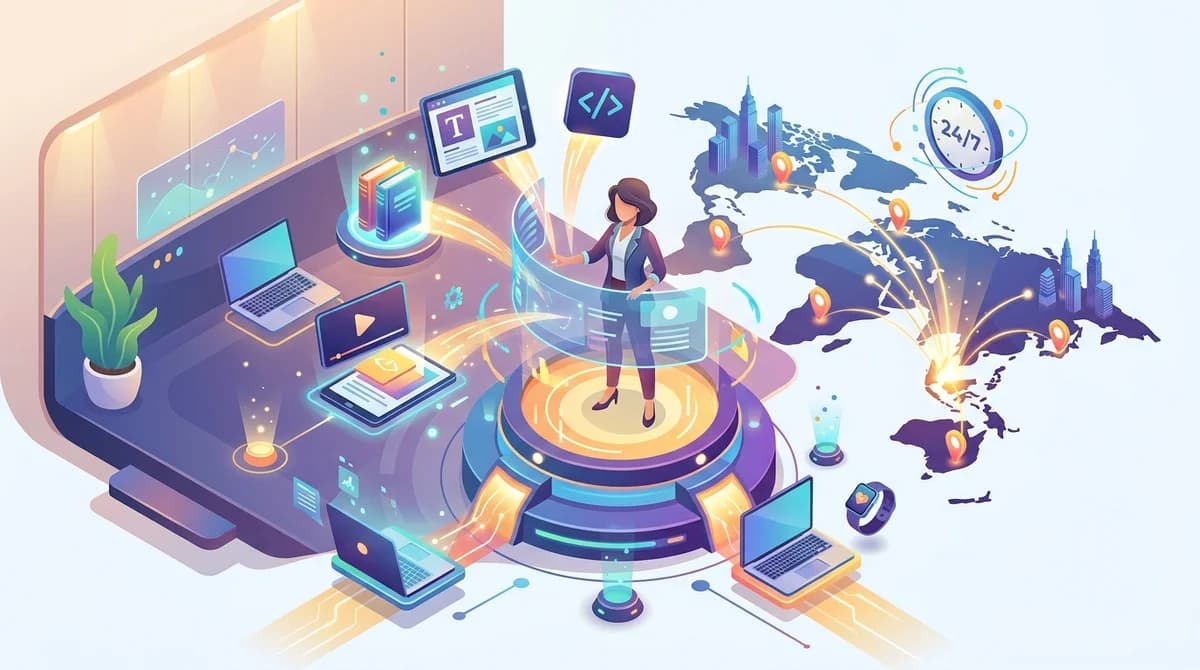

Building a Digital Empire 2026: Why Non-Physical Products Are the Future of Your Business
Imagine a morning in 2026. You are awakened by the chime of notifications on your cell phone—not an annoying alarm, but a sales report that came in while you were asleep. There's a buyer from Jakarta who just downloaded your marketing strategy e-book, a designer in Berlin who bought your UI/UX template, and an entrepreneur in Tokyo who subscribed to a simple automation tool you created. All this happens without you needing to wrap a single package, go to a shipping office, or worry about a crowded warehouse.
Sound like a dream scenario? For thousands of people in the digital products industry, this is a daily routine. We are on the verge of an era where the lines between physical products and intellectual value are increasingly blurred. 2026 is not just a number on the calendar; this is the culmination point where digital infrastructure, cross-border payment systems, and global technological literacy have come together perfectly to create the most democratic capital-free business opportunity in history.
Paradigm Shift: Why Now Is the Right Time?
The world no longer views digital products simply as “complements”. According to global market projections from Goldman Sachs Research, the global creator economy is projected to approach $480 billion by the middle to late decade. In Indonesia, accelerating internet adoption is no longer about entertainment, but efficiency. People are willing to pay for instant solutions: an Excel template that saves them five hours of work, or a video class that teaches a specific skill in one evening.
"In the new economy, the most valuable assets are not land or gold, but rather solutions that can be replicated at no additional cost."
The magic of this business lies in the marginal cost or additional cost for each unit sold. If you sell coffee, every second cup requires new coffee beans, milk, and labor. However, if you sell digital products, the 100th or 1,000,000th buyer doesn't add a penny to your production costs. This is what we call infinite scalability.
Beyond Borders: Global Opportunities from Your Desk
One of the biggest obstacles to traditional business is logistics. Sending goods overseas involves taxes, customs duties and risk of damage. In the digital product ecosystem, national borders are just lines on a map. With platforms like Gumroad, Etsy, and NFT markets that are now more functional, you can reach global markets with stronger currencies without leaving the house.
The advantages of currency arbitrage are the main attraction. For a creator in Indonesia, selling preset photos for $15 to the United States market may seem cheap to buyers there, but for sellers in Indonesia, that is a very significant figure. In 2026, global digital payments integration will become even more seamless, allowing currency conversions to occur in seconds without prohibitive fees.
The Spectrum of Digital Products that Dominate the Market
If you're wondering what can be sold, the answer is almost limitless. However, there are several categories showing consistent growth:
- Educational Assets: In-depth e-books, micro-video courses, and step-by-step guides on specific topics not taught in formal schools.
- Productivity Products: Notion templates, complex Google Sheets formulas, to project management checklists.
- Creative Assets: Custom fonts, graphic design elements, royalty-free music, and AI prompts that have been optimized for industry needs.
- Simple Software & Tools: Web-based micro-applications or browser extensions that solve one specific problem efficiently.
Starting With No Capital: Steps to Your First Launch
Starting this business does not require an investment of millions of rupiah for stock of goods. The main capital is expertise and time. The first step is to identify what problems people frequently ask you about. If you often get asked for help sprucing up your presentations, perhaps a professional PowerPoint template is your first product.
Second, create a minimum functional version. It doesn't need to be perfect at the start; what matters is providing real value. Use free or low-cost platforms to showcase your work. Over time, let testimonials from first-time buyers become your organic marketing engine.
Third, take advantage of the power of educational content. In the era of 2026, selling is no longer about shouting "buy my product", but about sharing knowledge. When you help others through free content, you automatically build authority and trust that will direct them to your paid products.
Towards Measurable Freedom
The digital product business is all about buying back your time. It's about creating something once, then letting it work for you over and over again. It does take hard work at the start to build the foundation and quality, but the result is an asset that will never wither or go stale in the warehouse.
The year 2026 is in sight, and the gates to the global digital economy are wide open for anyone who dares to start. Will you remain a spectator on the sidelines, or become a digital shop owner serving the world? The decision to turn knowledge into an asset is yours now. Start with one small idea, create a prototype, and let the world discover the unique value you offer.
P.S. Understand why digital product margins are so powerful in our breakdown of why digital product scalability is so compelling.
Comments
Share your thoughts or questions
Leave a Comment