
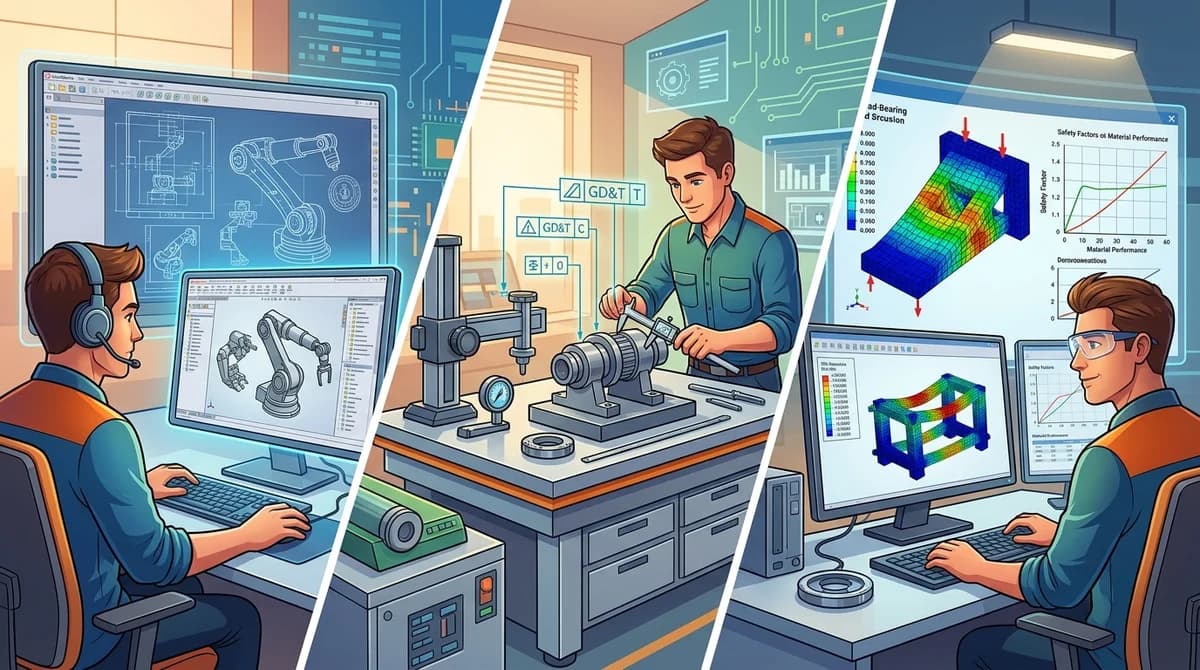

Behind the Design Desk: 3 Engineers' Secret Weapons for Breaking into Top Companies
Imagine you are in the waiting room of a multinational manufacturing company. In your hands you hold a Mechanical Engineering diploma with a very impressive GPA. However, when the door to the interview room opens, the question that arises is no longer about basic thermodynamic formulas, but rather how far you can translate your imagination into components that can actually be mass produced.
The reality of today's industry has shifted. In the era of manufacturing 4.0, a diploma is just an entry ticket, while mastery of specific tools and methodologies is the determinant of whether you will sit in your dream position or just be a spectator. Big companies like Tesla, Boeing, or General Electric are not just looking for someone who knows how machines work, but they are looking for creators who are precise and efficient.
If you want to truly be noticed by industry giants, there are three technical skills you must sharpen.
Go Beyond Lines and Curves with 3D CAD
In the world of modern engineering, Computer-Aided Design (CAD) software is no longer just an additional tool, but a mother tongue. Whereas engineers used to use large drawing tables, now everything happens in a digital space. Mastering software such as SolidWorks, Autodesk Inventor, or CATIA is a fixed price.
Why is this so crucial? Because this is where ideas are first given shape. However, just being able to draw a box or circle is not enough. Companies are looking for those who understand parametric modeling—the ability to build flexible designs where a single dimensional change will automatically logically adjust the entire component structure.
"Strong digital design is the foundation of production efficiency. Without a strong command of CAD, an engineer will lose the ability to communicate technically in a modern environment."
Bridging Imagination and Reality Through GD&T
Often times, a novice designer creates an image that looks perfect on the monitor screen, but is impossible for a CNC machine or technician to produce in a workshop. This is where Geometric Dimensioning and Tolerancing (GD&T) plays a vital role.
GD&T is an international system used to determine and communicate manufacturing tolerances. You have to understand that no component can be made with a truly precise size down to zero microns. Without a deep understanding of GD&T, your design can be very expensive because tolerances are too tight, or simply unassemblable because it is too loose.
Understanding symbols such as flatness, cylindricity, and positional tolerance proves that you are not only thinking about aesthetics, but also thinking about aspects of functionality and production costs. This is the skill that differentiates an ordinary "drafter" from a professional "design engineer".
Ensure Safety Before the First Bolt is Installed
Once the design is created and tolerances are established, the big question is: will this component hold up under load? This is where Finite Element Analysis (FEA) or basic structural analysis becomes a differentiator.
Instead of conducting costly trial and error experiments, top companies use FEA simulations to predict weak points in a design. You are expected to be able to carry out basic simulations to see where stress (stress) accumulates and whether the material will experience permanent deformation.
According to data from the American Society of Mechanical Engineers (ASME), integrating simulation in the early stages of design can cut product development time by up to 30%. By mastering FEA, you provide companies with a guarantee of material safety and efficiency, an added value that is very difficult for recruiters to ignore.
Steps to the Future Engineer
The three skills above—3D CAD, GD&T, and FEA—are a unified ecosystem that will increase your bargaining value in the job market. The world of engineering is no longer about who memorizes the most formulas, but rather who is most adept at using technology to solve real problems.
Start by taking on a small project, learn ISO or ASME standards for tolerances, and don't hesitate to test your own designs through digital simulations. The future of the industry is in the hands of those prepared with the right digital tools. Are you one of them? Let's start sharpening your weapons today and get ready for career offers you never imagined possible.
P.S. After honing modern engineering skills, unlock global career prospects with our remote work opportunities guide for design engineers.
Comments
Share your thoughts or questions
Leave a Comment