
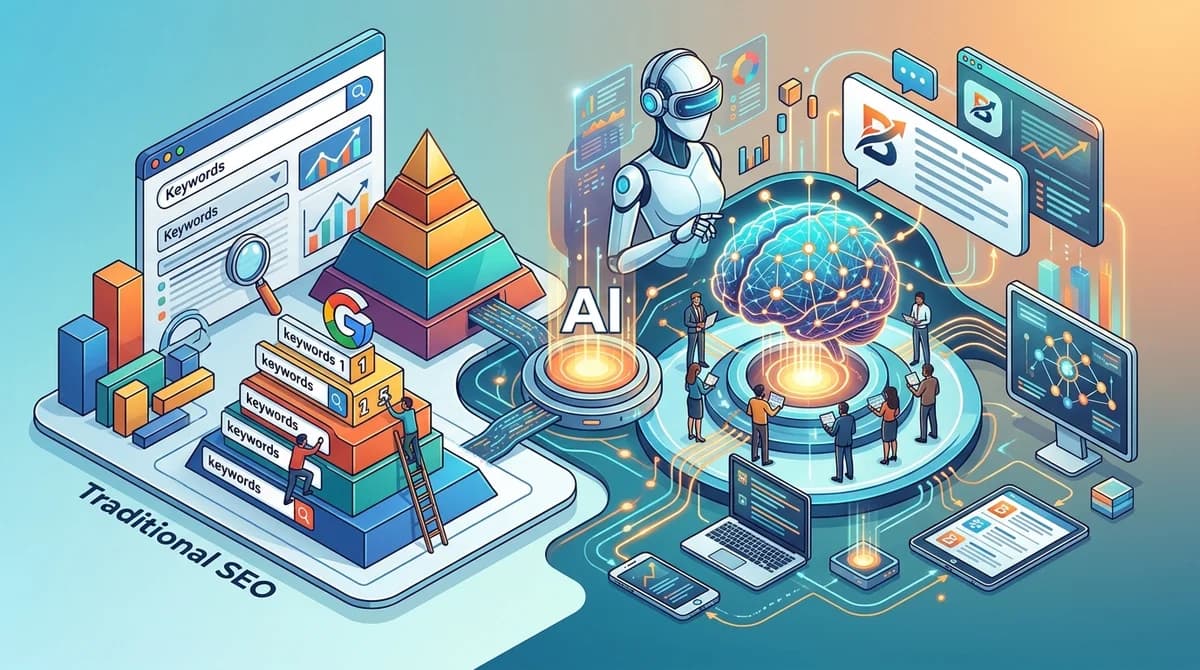

The Future of Search: Why Your Brand Must Win the Heart of AI Over GEO
Imagine that a potential customer no longer types short keywords into the Google search field, but instead asks a virtual assistant on his cellphone: "What is the best CRM software recommendation for a newly developing startup?" In a matter of seconds, the AI assistant doesn't provide ten blue links, but instead provides a concise answer paragraph that mentions one or two brand names, complete with reasons.
If your brand is not there, you are missing out on a future market. Welcome to the era of Generative Engine Optimization (GEO), a major evolution that is changing the way we view digital visibility.
Beyond Ten Blue Links
For the past two decades, digital success has been measured by ranking first on search pages. However, the emergence of technologies such as ChatGPT, Claude, Perplexity, and Google Search Generative Experience (SGE) have changed the rules of the game. Users now prefer straight answers rather than having to do independent research through various websites.
The basic difference between traditional SEO and GEO lies in the goals. SEO focuses on ranking algorithms based on keywords and backlinks, while GEO focuses on how Large Language Models (LLM) understand, summarize, and ultimately recommend your entity as the best solution to a user's question.
"In the AI ecosystem, authority is no longer about who gets the most clicks, but rather who can be trusted most to be part of the AI's answer synthesis."
A Look into the Kitchen of Artificial Intelligence: How Does GEO Work?
An interesting study from researchers at Princeton, Georgia Tech, and IIT Delhi revealed that certain content strategies can significantly increase a brand's visibility in generative search results. They found that AI tends to choose sources that have an authoritative sentiment, include relevant statistical data, and have an information structure that is easy for machines to process.
Optimizing for AI doesn't mean flooding content with keywords, but rather enriching content with context. The AI looks for “evidence of trustworthiness.” When a brand is frequently mentioned in a positive context by various other authority sources, AI will record it as a reference worth recommending to users.
Smart Tactics to Get Referred by AI
What are practical ways to get your business to appear on AI's recommendation radar? The answer lies in the quality of the narrative and data structure you present to the digital world.
Use Valid Data and Statistics
AI really likes numbers. Including original research data or industry statistics in your content makes the information appear more credible to LLMs. When AI constructs an answer, they often pull specific data to strengthen their argument, and that's when your brand can step in as a key referral source.
Build Authority Through a Specific Niche
Don't try to be everything to everyone. AI works by mapping relationships between concepts (knowledge graph). By consistently covering specific topics in depth and high quality, you build an identity as an expert in that field. This consistency makes it easier for AI to associate your brand with a particular solution.
Optimization of Authoritative Quotes and Testimonials
Make sure your brand is talked about by credible third parties. Reviews on trusted platforms, distribution in digital mass media, and citations from industry experts are strong signals to AI engines that your brand has a real reputation in the physical and digital world.
Welcoming the New Era of Digital Marketing
The transition to GEO is challenging, but it is a golden opportunity for those who prioritize content quality above mere algorithm tricks. This strategy forces us to go back to the roots of communication: providing real value, being a reliable source of information, and building a relationship of trust with the audience.
Is your content ready to be read and recommended by artificial intelligence? Start by evaluating whether the information you present today is valuable enough to be cited by even the smartest virtual assistant. Don't just chase rankings; pursue trust, because that is the main currency in this generative era.
If you want your brand to remain relevant in the future, it's time to move beyond search engine optimization to solution-delivering engine optimization. Start updating your content strategy now to stay top of mind on every user's screen.
P.S. After mastering GEO for AI search, also explore generative AI for large-scale content production efficiency.
Comments
Share your thoughts or questions
Leave a Comment